
How to build a realistic budget in South Africa
Most people struggle with budgeting because their budget was created around a version of life that only exists on paper.
It's the version of life where you always cook at home, spend the same amount on groceries every week, plan every event and birthday gift well in advance, and never need a last-minute Uber Eats after a long day at work. Real life looks different.
Some months come with five weekends. Some weeks feel expensive before they’ve even started. Sometimes you need to deal with new tyres, a baby shower gift, rising petrol prices, funding a school trip or an unexpected expense that was nowhere near your original plan.
That is why a realistic budget in South Africa needs to start with the life you actually live. A useful budget helps you understand where your money is going, what matters to you, and what needs to change so your money supports the life you want. It should not make you feel like you're constantly failing at a plan that was never realistic to begin with.
We've made a tool that helps you start with the major categories and gives you live feedback on some of your ratios. It also makes tracking easier, so you can see if your plan matches reality.
Start with what is really happening
The best place to start is with your actual spending, because your real numbers give you a better starting point than a perfect spreadsheet ever will.
Many people build budgets around what they believe they should be spending. They choose a grocery amount that feels sensible, a takeaway amount that feels responsible, and a savings goal that looks good on paper.
Instead, look at your last one to three months of spending and find out where your money actually went. Notice which categories were higher than expected, which expenses kept popping up, and which purchases still felt worth it afterwards. At the same time, pay attention to the spending that felt forgettable, rushed, or out of sync with what you actually value.
This is about gathering information, not judging yourself.
For example, maybe you budget R2,000 for groceries every month, but your actual spend is closer to R3,200. That does not mean you have failed at budgeting. It tells you that your household currently spends around R3,200 on groceries, and your budget needs to reflect that.
From there, decide whether to reduce that amount slowly, accept it as realistic for your household, or separate the extra top-up shops and convenience meals that keep pushing the number up.
Your income matters here too, especially if it changes month to month. Many South Africans do not work with one neat, fixed salary. Bonuses, commissions, freelance income, overtime, 13th cheques and side-hustle payments all make budgeting harder because the money does not always arrive in the same way at the same time.
If your income is irregular, build your budget around your lowest reliable monthly income first. Treat extra money as a tool for catching up, saving ahead, paying down debt or funding specific goals, rather than folding it into everyday spending.
Once you know what is really happening, you build a plan that works with your life rather than against it.
Build on the 50/30/20 rule
You may have heard of the 50/30/20 rule. It's one of the most common budgeting frameworks in South Africa and internationally. The basic idea is simple: 50% of your income goes to needs, 30% goes to wants, and 20% goes to savings or debt repayment. It's useful as a starting point because it gives your money some structure.
The problem is that it does not always reflect the realities of budgeting. Housing, transport, food, debt repayments, family responsibilities, school fees, medical costs and electricity often take up more than 50% of a household’s income before any “wants” enter the picture.
So instead of forcing your life into the 50/30/20 rule, use it as a reference point. Start with your real income and expenses first. Then look at where your money is going and decide what needs to change.
A realistic budget beats a neat formula every time.
Put your goals into the budget
A budget should, ultimately, help you move towards the things you want.
That may mean paying off debt, building an emergency fund, saving for an island holiday, taking a six-month sabbatical, starting a side passion project, upskilling yourself, moving, or simply feeling calmer every time you check your bank balance.
Before you focus only on expenses, ask what you want your money to help you do next. What would make you feel more secure? What would give you more options? What would make your day-to-day life feel easier?
Then turn those goals into monthly numbers, because goals become easier to manage when they have a place in your budget. If you want to take a December holiday and you think it will cost R12,000, divide that amount by the number of months you have left. If you have 12 months to save, put away R1,000 a month. If you have six months to save, that amount becomes R2,000 a month. If you only start in October, you’d need R4,000 a month.
The goal stays the same, but the monthly amount changes depending on when you start planning. Giving your goals space in your budget gives them a better chance of becoming part of your real life.
Create mini freedom funds
Mini freedom funds are small savings pots for the things that give you more choice, flexibility and breathing room. Each one has a clear job, which makes it easier to protect and easier to use when the time comes.
Look at what is likely to come up over the next 12 months and start saving for those costs in smaller, more manageable amounts. You might plan for things like holidays, car services, birthdays, school breaks, festive season spending, home maintenance, tech upgrades, career flexibility or self-care.
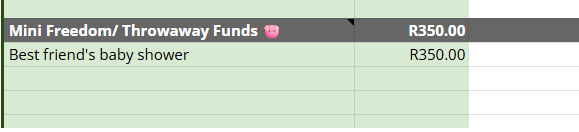
The more specific the fund is, the easier it becomes to understand why it matters. “Best friend’s baby shower” feels much clearer than “savings”.
Keep these funds away from your main account, because money that sits in one big pool disappears into the general blur of the month.
Your main account should cover bills and debit orders. Your spending account should cover groceries, petrol, eating out and everyday costs. Your emergency fund should sit in a separate savings account. Your mini freedom funds should sit in separate savings pockets or another easy-to-access savings account where they are less likely to be spent without thinking.
Many major South African banks offer savings pockets, notice-free savings accounts, or goal-based savings features that sit alongside your main account. These are useful for short-term funds because they keep the money separate while still giving you access when you need it.
For money you may need soon, prioritise easy access and low fees. For short-term savings, look for savings pockets or money market-style accounts that offer instant liquidity and better returns than leaving cash in your transactional account. Avoid locking this money away if the whole point is to use it for a planned expense in the next few weeks or months.
The idea is to give every Rand a job before it disappears.
Make saving happen early
Many people plan to save whatever is left at the end of the month, but by then, life has usually happened.
A quick coffee with an old friend becomes a three-course dinner at a pricey restaurant. A quiet weekend becomes a birthday lunch, a grocery top-up, and a school project run.
For example, on payday, automate R500 to your emergency fund, R300 to your car fund, R200 to your holiday fund, and R250 extra towards debt repayment. Once those amounts have moved, build the rest of your month around what is left

Saving first helps the important things happen instead of leaving them to compete with everything else at the end of the month.
Budget for the way you actually spend
Flexible costs are the categories that move around each month. They are often the ones that make a budget feel difficult to stick to.
These include groceries, clothing, petrol, eating out, entertainment, transport, data and small everyday purchases.
Because these areas are closely tied to real life, they need honest numbers rather than hopeful guesses.
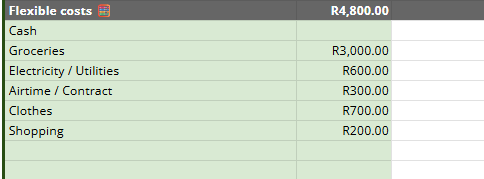
If you enjoy seeing friends over dinner once a week, build that into your budget. Instead of hoping the spend will somehow disappear, budget R1,200 a month for eating out.
That gives you one planned dinner a week, and takeaways come from the same category. When the money is done, choose a cheaper plan without feeling like the whole budget has fallen apart.
The same applies to shopping. If you know you enjoy buying a few clothing items each month, plan for it instead of pretending it will not happen. Set aside R1,000 a month for clothing and shopping. That way, when you want a new jacket or pair of jeans, the money is already part of the plan instead of becoming “unexpected” spending.
A realistic budget does not remove joy from your life. It helps you decide which joys are worth planning for.
Plan for longer months
Some months cost more simply because they have more spending days.
If you budget for four weeks of groceries, petrol, school lunches, or transport, a five-week month will throw everything off.
A simple way to make your budget more realistic is to work with 4.3 weeks instead of four.
If groceries cost around R1,000 a week, a more realistic monthly budget is R4,300 rather than R4,000. That extra R300 helps smooth things out across the year, so you're not caught off guard every time a month stretches a little longer.
Create a fifth-week buffer for categories that run weekly, like groceries, petrol, transport, school lunches, data, electricity and entertainment.
In a four-week month, keep the extra as a buffer. In a five-week month, you already have some of the extra week covered.
It's a small tweak, but it makes your budget feel much more grounded in real life.
Listen to what your emergency fund is telling you
Your emergency fund is there for true surprises, like an unexpected bill, car repair, urgent home repair, medical shortfall, or sudden travel need.
If you keep dipping into it before month-end, treat that as feedback, not failure.
It may be a sign that:
- Your budget needs more room
- Certain costs are being underestimated
- Your flexible spending needs more structure
- Predictable expenses need their own mini funds
Look at the last few times you used your emergency fund and ask:
- What did the money go towards?
- Should this have been planned for?
- Has this type of expense come up before?
If the same expense keeps appearing, it needs its own category.
For example, new tyres feel sudden when you have to pay for them, but they are not completely unpredictable. A small car maintenance fund helps you prepare ahead of time and keeps your emergency savings for the things you truly could not see coming.
Keep coming back to your budget
Your budget should change as your life changes. Start with your best estimate, compare it to what actually happened, and adjust from there.
After each month, look at where you overspent, what surprised you, and what needs tweaking. Small changes make your budget more realistic and easier to trust over time.
A quick weekly check-in also helps. Spend 10 minutes a week reviewing what came in, what went out, and what is still coming up.
The more your budget reflects your real life, the easier it becomes to stick to. It gives your money a plan that supports the life you want to build, rather than making you feel like you're constantly giving something up.
Get started today with our simple budgeting tool to track your spending, set meaningful goals, and build a budget that fits your real life.
Get the Money Systems newsletter: Practical money tools for real South African life
Tools that might be helpful:
Tool | Habits and systems: What your everyday spending is actually costing you
Setting a money baseline: How to track your spending without hating it
Budgeting email course: Build a plan that funds your goals
How to plan your year without money stress running the show
How to spend guilt-free and make space for real-life things: A practical workbook
Spend smarter on big buys with this practical workbook
Build a budget that reflects your life, not just your bills: A simple guide
Align your budget with what matters: A practical workbook
Other resources to explore:
Fixed expenses in South Africa: how much of your salary should go to monthly costs?
Money on their minds? The distraction costing your team energy and motivation
FAQs about building a realistic budget in South Africa
What is the best way to start building a realistic budget in South Africa?
Look at your actual income and spending first. Review your last one to three months of transactions, group your expenses into categories, and compare your real spending to what you thought you were spending. From there, build your budget around your real costs, goals, debt repayments and savings needs.
Does the 50/30/20 rule work in South Africa?
The 50/30/20 rule is a useful starting point, but it does not work perfectly for every South African household. Many people spend more than 50% of their income on essentials like rent, transport, food, debt, electricity, medical costs and family responsibilities. Use the 50/30/20 rule as a guide, then adjust it around your real numbers.
How do I budget if my income changes every month?
If your income changes every month, build your budget around your lowest reliable monthly income. Use that amount to cover essentials, debt repayments and minimum savings. When extra money comes in from commission, bonuses, freelance work, overtime or a 13th cheque, give it a specific job before spending it. Use it to build your emergency fund, pay down debt, save ahead for expensive months, or fund a specific goal.
How much should I save each month?
Your savings amount depends on your income, expenses, debt and goals. Start with an amount you can repeat every month, even if it feels small. Saving R200 consistently is better than planning to save R2,000 and stopping after one month. Once your budget becomes more stable, increase your savings amount over time.
Where should I keep my mini freedom funds?
Keep mini freedom funds separate from your main spending account. Use savings pockets, goal-based savings accounts, or easy-access savings accounts offered by major banks. For short-term goals, prioritise low fees, easy access and a better return than your transactional account. Avoid locking away money that you expect to use soon.
What should I do if I keep overspending?
If you keep overspending, review the categories where it happens most often. Your budget may be too strict, your flexible spending may need more structure, or a predictable expense may need its own savings pot. Overspending gives you information. Use it to adjust your budget instead of abandoning the plan.
How often should I review my budget?
Review your budget once a week for a quick check-in and once a month for a fuller reset. The weekly check-in helps you stay aware of what has come in, what has gone out, and what is still coming up. The monthly review helps you update your categories, savings goals and spending limits based on what actually happened.

.png)
.png)
.png)