
10 ways to save money ahead of the festive season
December is supposed to be fun. Time off, family, food, holidays, sunny days. But for many people, the month gets expensive fast.
Early pay cheques, gifts, travel, school holidays, and social plans. Everything piles up at once.
By the time January arrives, you are facing regular bills, school fees, and a long stretch until the next payday. The stress has nothing to do with being “bad with money”. December simply compresses spending into a much shorter window.
The Wealthbit December and January Prep Tool helps you map the months together so you can enjoy the season without carrying the financial stress forward.
See why December drains money faster than you expect
December changes the rhythm of your finances:
You spend heavily in two or three weeks, often after being paid early. That means January becomes a longer-than-usual month with more obligations and less remaining income.
Understanding this rhythm is the first step to planning a December that feels good now and still leaves room for January to be manageable.
Decide what you actually want to spend on
Before you make a shopping list or plan parties, ask yourself what you actually want December to feel like.
Do you want it to feel calm, connected, joyful, playful, or stress-free?
Being clear on this helps you choose what deserves your time and money. Most people realise that the moments they remember most are not the most expensive ones.
Score your plans by joy and cost
The things that bring the most joy often don’t have to be the ones that cost the most. Look back at past holiday seasons. What activities made you happy, and which left you stressed?
Understanding your personal joy versus cost ratio helps you focus on experiences that matter. The goal is not necessarily to spend less. The goal is to spend better. Choose experiences that create memories, not debt.
The Joy versus Cost exercise helps you rate each activity or expense for joy and cost. Did buying lots of gifts really give you joy? Or was your trip to Vietnam much more rewarding?
Add your own experiences under “Choices”. Then give each of them a rating for the joy they brought and how much they cost. A rating of “1” means “low” and “3” means “high”.
.gif)
Once you’ve added your choices and scores for joy and cost, you’ll see the graph change. It becomes obvious where your high-joy items sit, where your low-joy costs hide, and what is worth prioritising.
Set up your budget for December
Set up your usual monthly budget in the Monthly Budget Overview tab so that you know what you’re working with.
This will automatically pull into the December Planner. In the December planner tab, you then only need to add your total savings amounts for: Freedom, life goals, and throwaway funds.
These are savings you plan to use for things that don’t happen every month. Make sure to mark any savings pockets that are dedicated to December with a tick on the right!
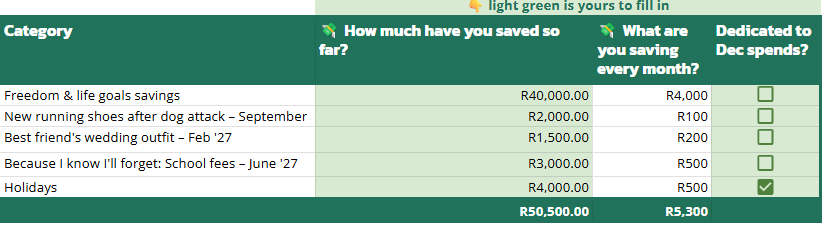
Map out your December plans and costs in one place
Now it’s time to map out your December plans, including gifts, travel, family activities, and social events you already know will happen. Try to reflect on what typically trips you up, and add your budget allocation or actual cost.
Decide where this money will come from. Is it from your monthly income, a dedicated savings account, other savings, or a credit card?
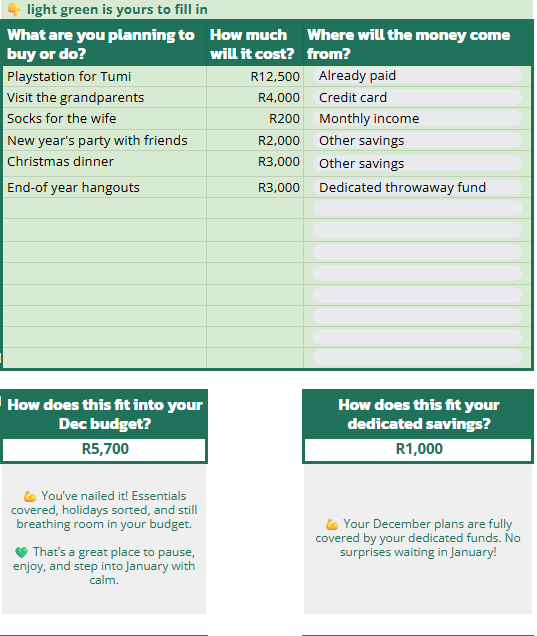
The grey blocks underneath this table will give you live feedback: Are your choice funds covering your plans? Do you maybe have to reshuffle? What will the tradeoffs be?
You can see potential tension and make deliberate choices. Perhaps you adjust a gift, swap a costly outing for something simpler, or move funds around.
It is all about clarity and adjusting according to what you can afford.
Adjust your plan before the money starts moving
Once you’ve mapped your plan and decided where the required money needs to come from, go to the bottom of the sheet. A few small changes before the month begins can prevent the kind of last-minute overspend that creates January anxiety.
Make explicit where you’ll transfer savings.

Tools to avoid a financial hangover in January
- Use the December planner to prep for January early. January pressure often comes from forgetting how many obligations land at once. The tool pulls your December decisions forward so you can set aside what you need or plan for the bigger items.
This makes January feel far more manageable.
- Idea bank: maximise joy without maxing out your card. Collect budget-friendly tips from friends, family, and your community. Think DIY gifts, heartfelt notes, potluck dinners, or low-cost activities like hikes, board games, or movie nights.
The mini-idea bank in your workbook has even more creative ways to make December joyful and affordable.
- Track your January spend week by week. The January spend tracker lets you plan and monitor your spending week by week. Data is automatically pulled in from your December planner inputs.
Add your regular bills, expenses, and any leftover holiday spending.
Tracking your expenses this way helps you see exactly where your money is going, avoid overspending, and stay on track with your budget throughout the month.
Sign up for Wealthbit’s Money Systems newsletter and make financial freedom simple.
Tools that might be helpful:
Budgeting email course: Build a plan that funds your goals
Setting a money baseline: How to track your spending without hating it
Spend smarter on big buys with this practical workbook
Build a budget that reflects your life, not just your bills: A simple guide
Tool | Habits and systems: What your everyday spending is actually costing you
How to plan your year without money stress running the show
Align your budget with what matters: A practical workbook
Other resources to explore:
Fixed expenses in South Africa: how much of your salary should go to monthly costs?
Money on their minds? The distraction costing your team energy and motivation

.png)
.png)
.png)